
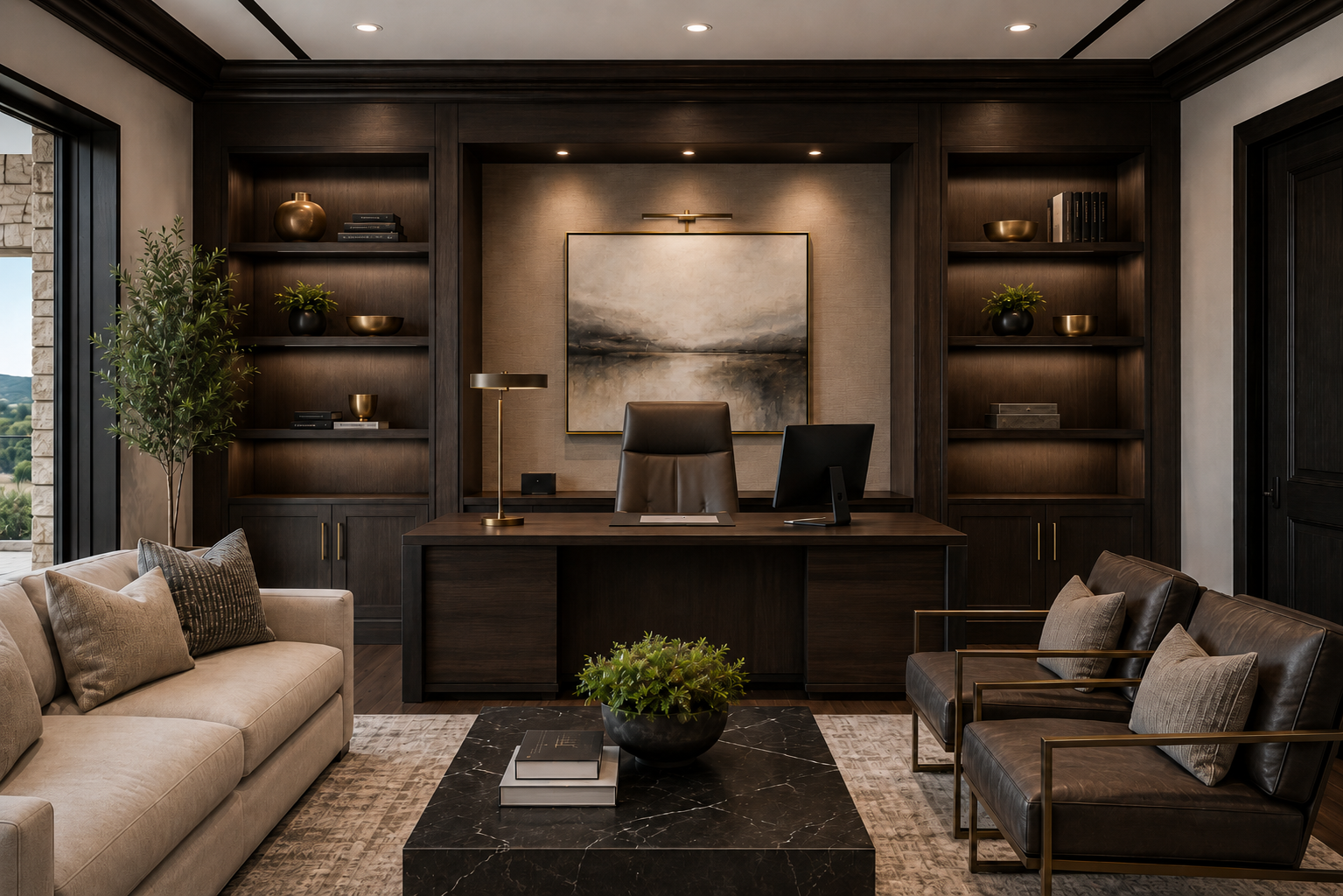
Professional environments shaped through operational clarity, institutional credibility, and disciplined design.
Principal-led interior strategy, design direction, procurement planning, and project stewardship for executive offices, professional suites, churches, educational institutions, medical and wellness environments, nonprofit organizations, and stakeholder-facing spaces throughout Greater Houston and select markets.
These environments must support the institution as effectively as they represent it.
Executive and institutional interiors carry responsibilities that extend beyond visual presentation. They influence how leaders work, how teams communicate, how visitors are received, how confidential matters are handled, and how the organization is perceived by the people it serves.
Adorn begins by examining the environment in relation to leadership priorities, operational use, stakeholder expectations, organizational culture, material performance, and future growth. Design decisions are then developed within a defined framework that supports clarity, accountability, and long-term continuity.
For organizations whose physical environment influences trust, performance, and stakeholder perception.
Executive and institutional interiors are most effective when the environment must support leadership presence, operational clarity, client experience, team function, credibility, and future growth.
Projects may involve one high-priority space, a defined suite, an administrative environment, or a broader institutional campus initiative.
Executive and professional organizations
Law firms, financial offices, corporate suites, consulting firms, private practices, and professional-service environments.
Churches and ministry campuses
Leadership offices, administrative environments, reception areas, meeting rooms, ministry-support spaces, and stakeholder-facing areas.
Educational and nonprofit institutions
Administrative offices, advancement environments, boardrooms, donor-facing spaces, leadership suites, and program-support areas.
Medical and wellness operators
Professional suites, wellness environments, waiting areas, consultation rooms, administrative offices, and client-facing interiors.
Design decisions are considered through the organization, not only the room.
Adorn approaches executive and institutional interiors as working environments with reputational, operational, financial, and stakeholder implications.
The design process considers how the organization receives people, conducts meetings, supports leaders and staff, communicates authority, manages change, and preserves continuity across future phases.
Leadership Presence
Creating environments that appropriately reflect authority, confidence, professionalism, and organizational maturity.
Operational Function
Considering circulation, workflow, privacy, meeting needs, storage, technology, accessibility, and daily use.
Stakeholder Experience
Improving how clients, donors, members, visitors, patients, partners, and employees experience the organization.
Institutional Continuity
Establishing design and material standards that can support future phases, maintenance, expansion, and organizational growth.
Leadership & Executive Suites
Executive environments should communicate authority without excess, provide privacy without isolation, and support the practical responsibilities of leadership.
Executive-suite support may include:
Reception & Stakeholder Environments
Reception and arrival spaces influence trust before formal interaction begins. These environments should feel intentional, operationally clear, professionally appropriate, and aligned with the organization’s identity.
Stakeholder-facing areas may include:
Boardrooms & Meeting Spaces
Meeting environments should support focus, communication, confidentiality, technology, governance, hospitality, and the practical movement of people and information.
Meeting-space planning may include:
Commercial Interior Strategy
Commercial interior strategy helps organizations identify how physical space can better support service delivery, client confidence, employee function, workflow, and market positioning.
Strategic support may include:
Institutional & Campus Environments
Churches, schools, nonprofit organizations, and mission-driven institutions often serve multiple audiences within facilities that have evolved over time. Adorn helps clarify interior priorities and develop a more coherent environmental strategy.
Institutional support may include:
Medical & Wellness Interiors
Medical and wellness environments must balance professionalism, privacy, comfort, operational use, cleanability, brand perception, and the emotional experience of patients or clients.
Relevant spaces may include:
Procurement & Implementation Planning
Institutional procurement requires disciplined specifications, approvals, purchasing responsibility, lead-time awareness, vendor coordination, receiving strategy, delivery planning, and continuity across multiple stakeholders.
Procurement planning may include:
Institutional Project Stewardship
Project stewardship supports continuity between approved design direction and the organizational decisions required to move the work forward. Adorn helps structure communication, approvals, procurement awareness, implementation priorities, and design-intent continuity within the agreed scope.
Stewardship may include:
Support may focus on one priority environment or a coordinated collection of institutional spaces.
Final scope depends on the organization, facility, operational needs, project phase, stakeholder structure, capital readiness, geography, and required level of design and implementation support.
Executive Offices
Leadership offices, principal suites, private meeting areas, and senior administrative environments.
Reception & Arrival
Reception desks, waiting areas, visitor pathways, security touchpoints, and stakeholder-facing entry environments.
Boardrooms
Governance, conference, presentation, donor, executive, and high-level meeting spaces.
Administrative Offices
Staff workspaces, department offices, support environments, collaboration areas, and shared administrative zones.
Church & Ministry Spaces
Leadership, ministry, administrative, member-facing, donor, meeting, and campus-support environments.
Educational Institutions
Administrative suites, head-of-school offices, advancement spaces, boardrooms, and parent-facing environments.
Medical & Wellness Suites
Waiting, consultation, administrative, counseling, wellness, and professional-client environments.
Professional Service Offices
Legal, financial, consulting, brokerage, advisory, and other credibility-sensitive professional environments.
Strong projects begin with authorized leadership, defined priorities, and a workable decision structure.
The full project does not need to be resolved before inquiry. However, the organization should have enough internal clarity for Adorn to evaluate the facility, priorities, project phase, authority structure, capital expectations, timeline, and required level of support.
Authorized sponsor
An executive, owner, board representative, facilities leader, or authorized project sponsor is involved in the inquiry.
Defined facility
The organization owns, leases, is acquiring, renovating, planning, or actively evaluating an identified environment.
Capital awareness
Professional fees, furnishings, materials, technology, freight, installation, construction, and specialized consultants are understood as separate project costs.
Decision structure
The organization is prepared to identify reviewers, approvers, stakeholders, communication protocols, and final decision authority.
Institutional work begins with fit, feasibility, and organizational clarity.
Submission does not reserve availability or create a professional engagement. Each inquiry is reviewed for facility type, scope, authority structure, project phase, geography, timeline, capital alignment, operational considerations, and fit with the firm’s capabilities.
Submit the institutional inquiry
Provide information about the organization, facility, project objectives, scope, current phase, timing, stakeholders, and projected capital allocation.
Principal review
Adorn evaluates strategic fit, readiness, geography, authority structure, current availability, and whether additional documentation is required.
Qualified next stage
Appropriate organizations may be invited to consultation, site review, feasibility assessment, scope definition, or another relevant next stage.
Written engagement
Services begin only after scope, responsibilities, authority, fees, communication protocols, exclusions, and engagement terms are documented and accepted.
Institutional complexity requires clearly defined professional roles.
Adorn provides interior strategy, design direction, furnishings and finish curation, procurement planning, presentation support, and project stewardship as defined by written agreement.
Specialized responsibilities remain with qualified professionals.
Architectural, engineering, construction, life-safety, code, ADA, clinical, environmental, legal, financial, regulatory, technology, security, and inspection services should be performed by appropriately licensed or qualified parties.
Every institutional engagement is individually defined.
Services, deliverables, decision authority, purchasing responsibility, stakeholder participation, project communication, exclusions, and implementation roles vary by engagement and are established in writing.
A full-scale Houston institutional interior shaped around executive authority, operational function, inclusive comfort, and a refined stakeholder experience.
Modern Sophistication is an active executive and institutional interiors engagement for a growing Houston organization. The project brings together reception, leadership, administrative, hospitality, meeting, and boardroom environments through a clean contemporary design language grounded in disciplined planning, material continuity, operational clarity, and long-term institutional use.
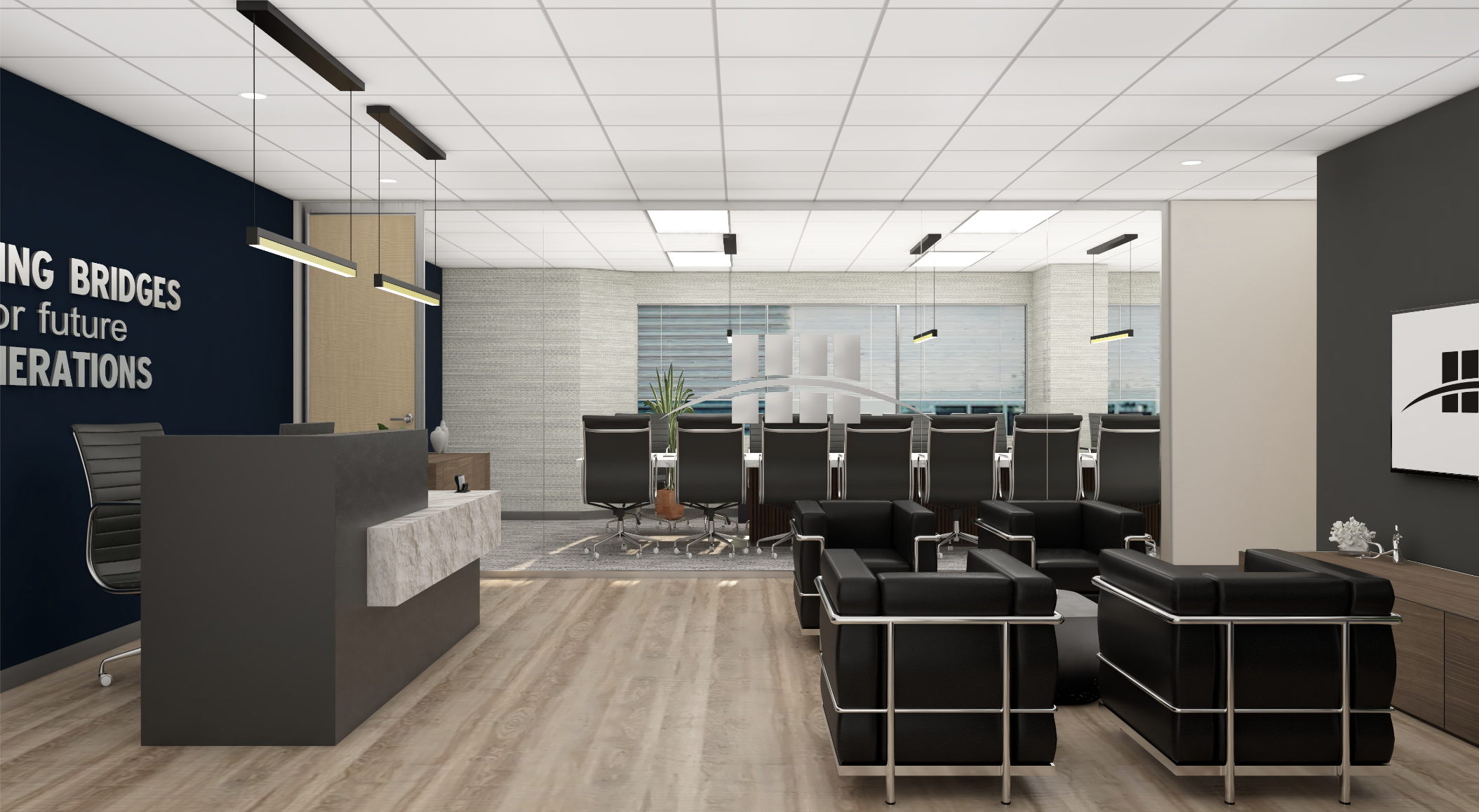
A contemporary institutional environment developed for credibility, capacity, comfort, and future growth.
The engagement is focused on creating a cohesive professional environment that supports executive leadership, staff operations, stakeholder meetings, hospitality, reception, formal governance, and organizational presentation.
The design direction uses controlled architectural lines, Naval Blue, deep walnut, white quartz with subtle gray veining, tailored commercial seating, integrated storage, concrete-look and charcoal reception elements, raised aluminum signage, and contemporary lighting.
The environment must perform at the scale and seriousness of the organization.
The project requires a coordinated interior framework capable of supporting leadership, large-format governance meetings, staff function, visitor comfort, hospitality, organizational presentation, and future institutional growth.
Executive and stakeholder credibility
Create an environment that communicates organizational maturity, leadership presence, professionalism, and confidence.
Operational clarity
Support reception, circulation, administrative work, hospitality, private meetings, presentations, and formal governance through clearly considered zones.
High-capacity boardroom function
Develop a custom boardroom table and meeting environment equipped to seat up to 30 people while supporting technology, visibility, circulation, comfort, and formal presentation.
Inclusive furniture performance
Specify commercial furniture capable of supporting varied weights, heights, body types, mobility needs, and sitting preferences across guest, staff, office, common-space, and boardroom environments.
Material and design continuity
Establish a cohesive material and furnishing direction across reception, executive, administrative, lounge, hospitality, and boardroom spaces.
Institutional identity and signage
Use raised aluminum letters displaying “BUILDING BRIDGES FOR FUTURE GENERATIONS” on the wall behind the reception desk.
Naval blue, warm walnut, and refined white quartz establish a disciplined contemporary foundation.
The selected palette creates executive presence, warmth, durability, visual clarity, and continuity without relying on excessive ornamentation.
Naval Blue
SW 6244 · #2F3D4CBrings depth, executive presence, and calm definition to feature walls, upholstery, and selected architectural moments.

Deep Walnut Wood
Furniture · Cabinetry · MillworkIntroduces warmth, durability, visual weight, and an established institutional character.

White Quartz
Subtle Gray VeiningProvides a clean, refined, durable surface for reception hospitality, work surfaces, and selected countertop applications.
A coordinated environment developed across public, leadership, meeting, hospitality, and operational spaces.
The supporting studies demonstrate how one design language is carried through multiple institutional functions.
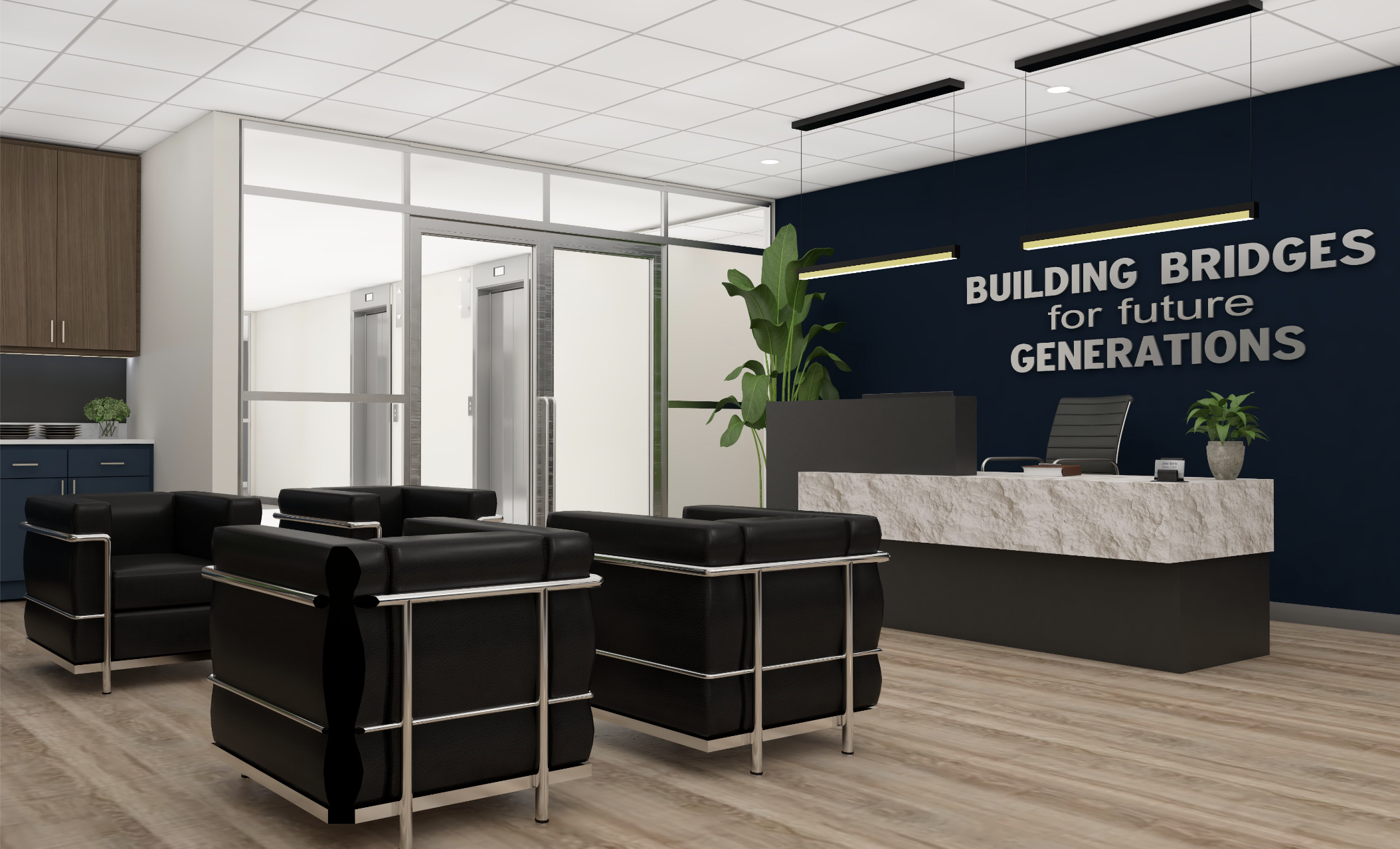
Institutional Interior Direction
Material, furniture, lighting, and architectural direction supporting a consistent professional experience.
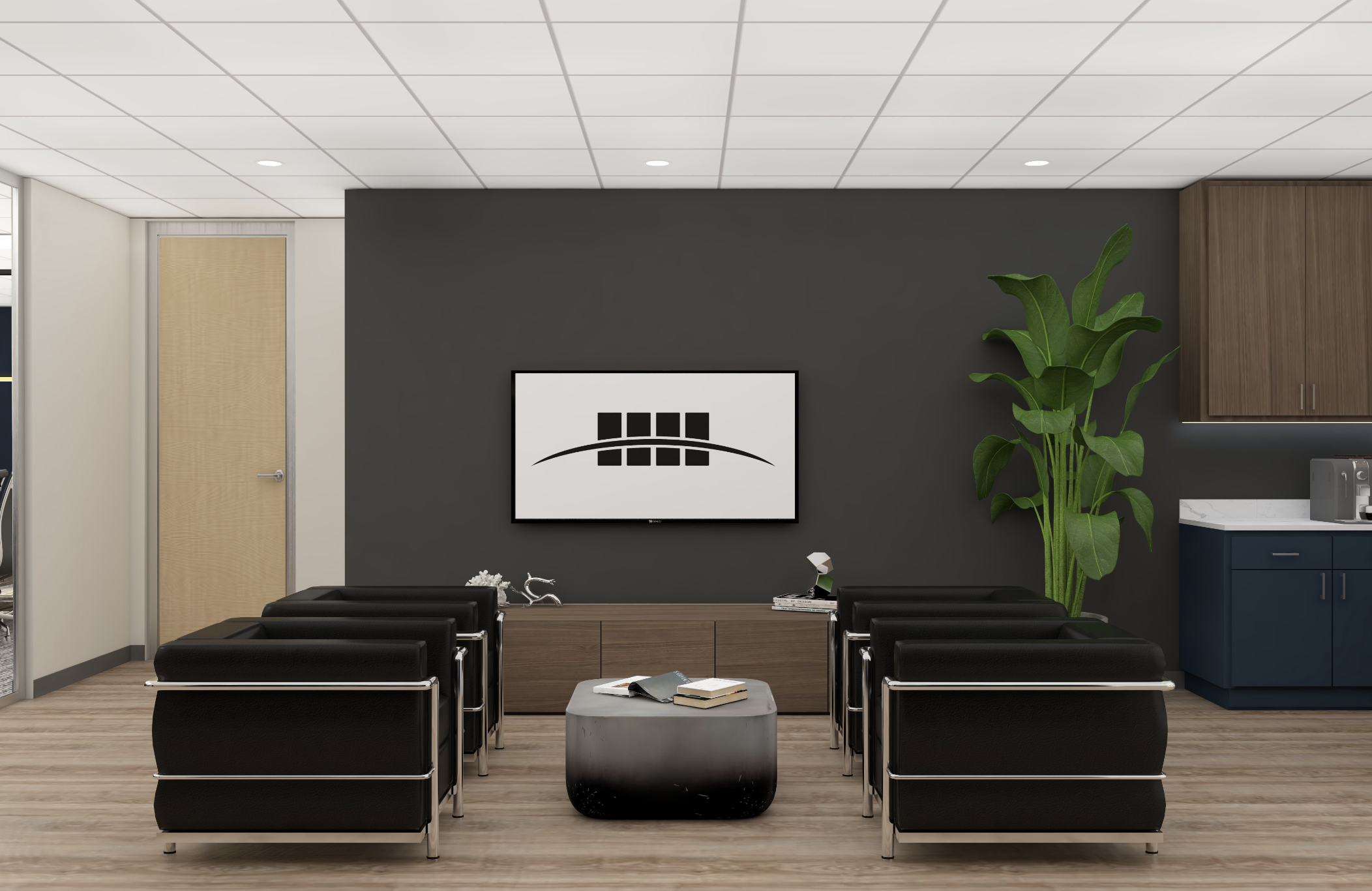
Reception Lounge & Guest Seating
A visitor environment balancing circulation, conversation, hospitality, accessibility, and varied seating needs.
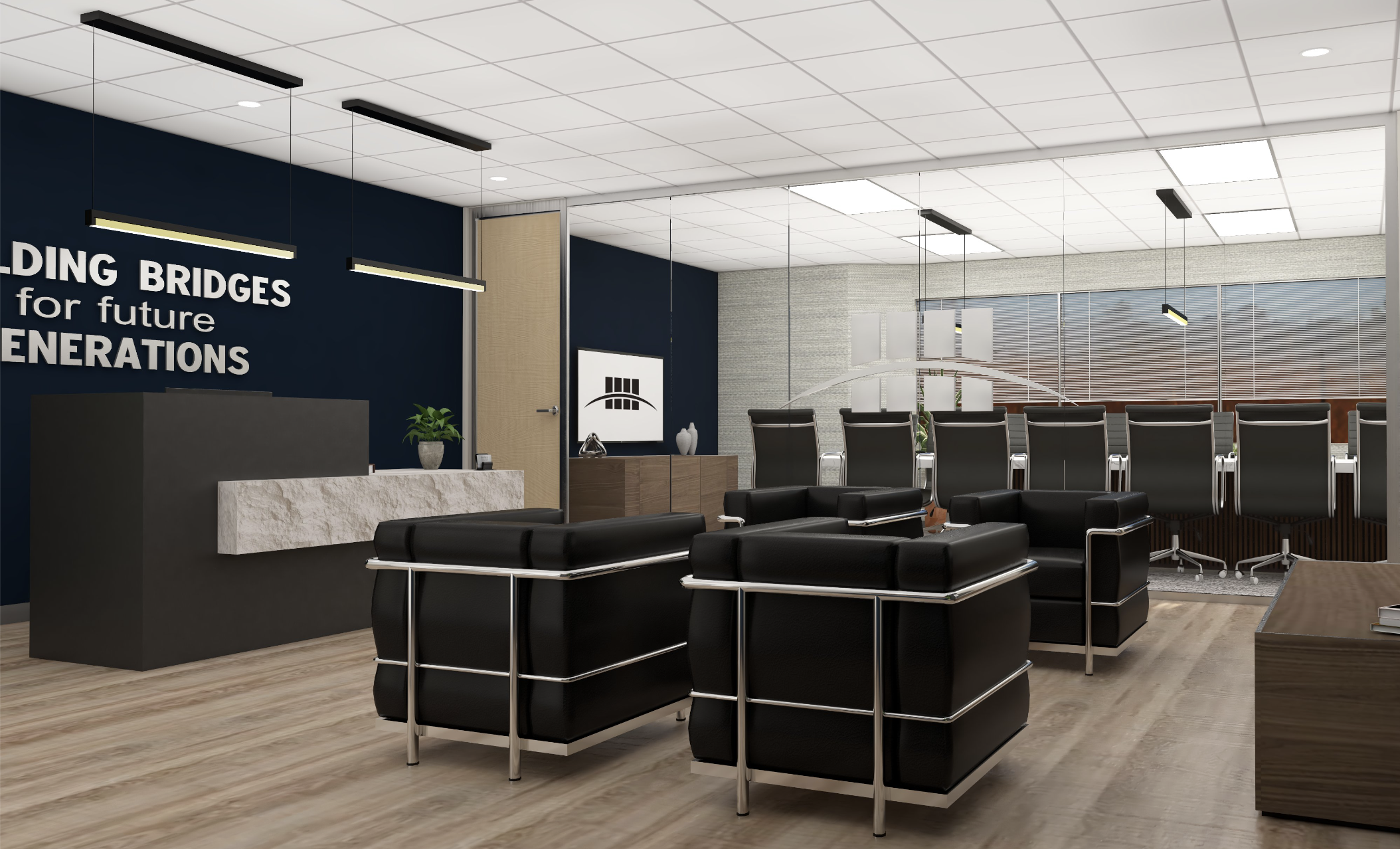
Reception-to-Boardroom Continuity
Design development connecting arrival, lounge, leadership, and governance environments.
A formal governance environment designed to accommodate up to 30 people.
The boardroom requires a custom table solution supporting large meeting capacity while preserving circulation, visibility, presentation access, executive comfort, and an appropriately scaled institutional presence.
Seating specifications must support varied weights, heights, and body types while the surrounding environment coordinates technology, lighting, acoustical considerations, wall treatments, storage, and hospitality functions.
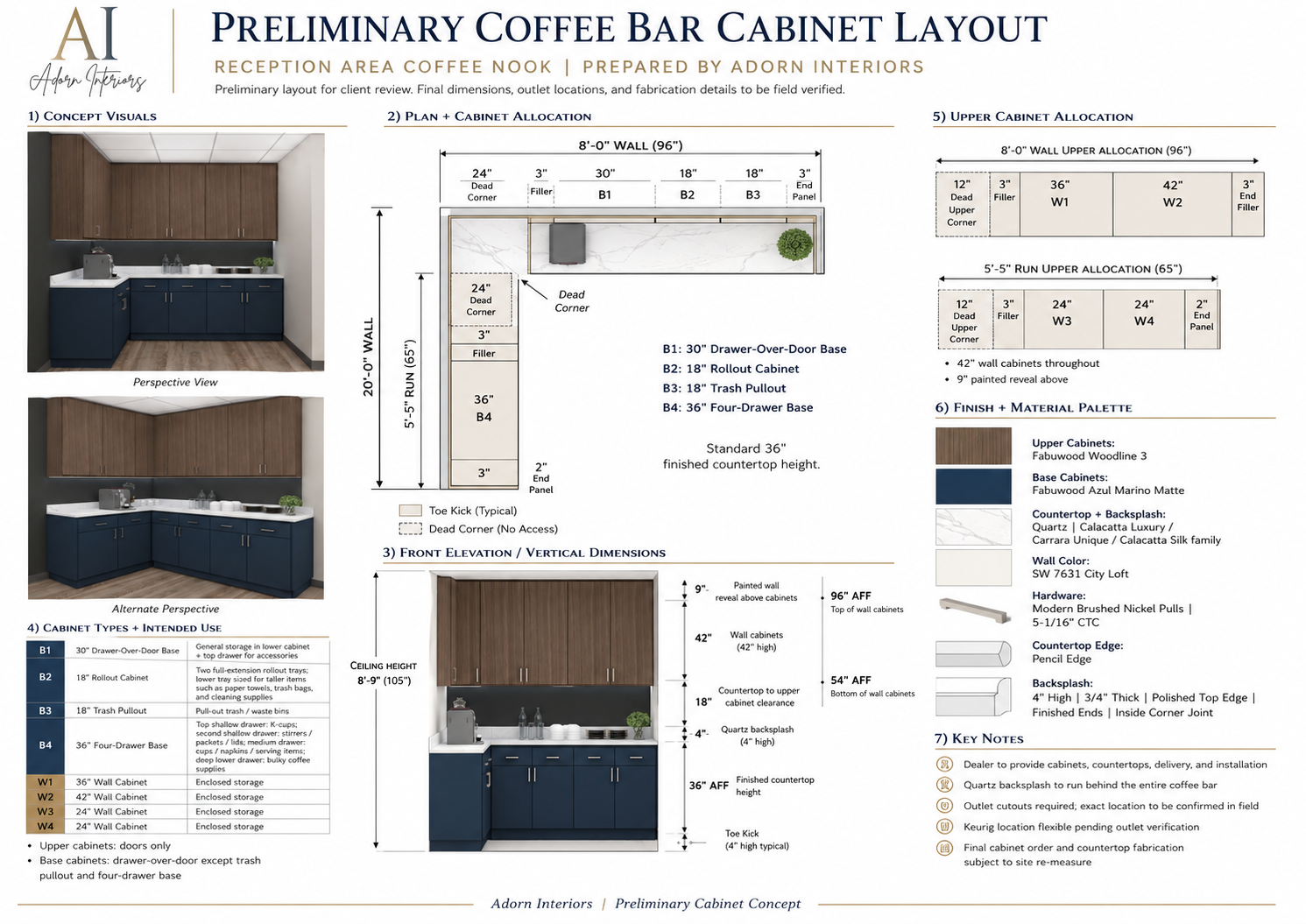
Preliminary coffee and snack bar planning moves the concept into functional cabinet development.
The reception hospitality area was developed beyond a decorative concept to address cabinet function, storage allocation, vertical dimensions, equipment needs, material direction, and daily organizational use.
The presentation sheet establishes the relationship between visual intent and practical cabinet planning before final coordination, specifications, field verification, and implementation.
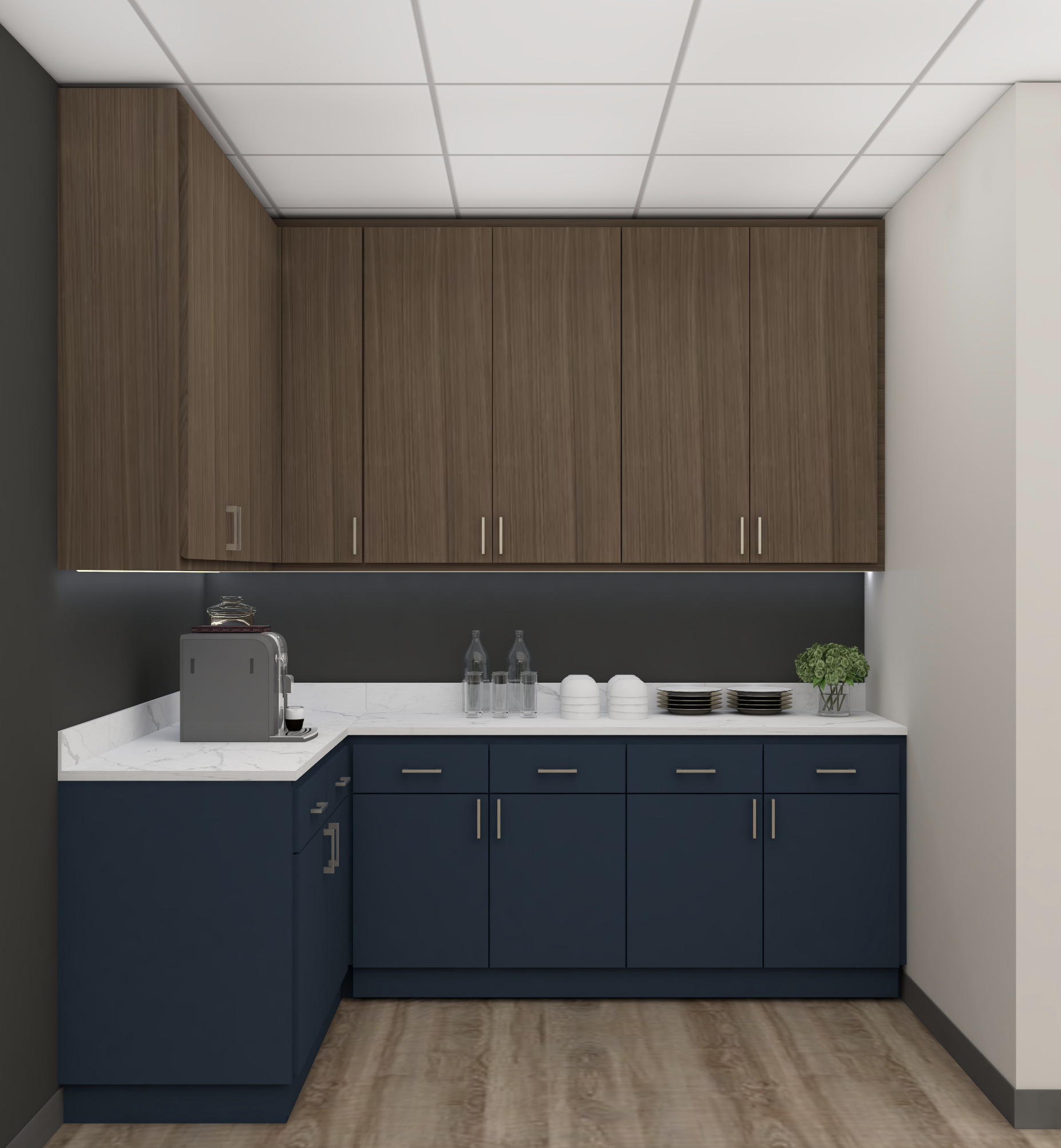
The coffee and snack bar supports daily operations and a more intentional guest experience.
The hospitality zone extends the project’s contemporary palette through deep walnut cabinetry, white quartz with subtle gray veining, integrated storage, equipment planning, and a polished presentation suitable for staff, leadership, board meetings, and visiting stakeholders.
The rendering demonstrates how the preliminary cabinet plan translates into a complete hospitality environment while remaining visually connected to the reception lounge and broader institutional interior.
Tell us about the organization, the environment, and the priorities the project must support.
Submit an Executive & Institutional Inquiry so Adorn can review the facility, project phase, intended scope, decision structure, timeline, projected capital allocation, and alignment with the firm’s capabilities and availability.